

1:1 prep and recording
Load manager conversations with context and keep action items tied to follow-through.
Use case
This page is for the leader who can feel the team slowing down but does not want to reduce a people problem to guesswork or anecdote.
Best cadence
Weekly
review with the same rhythm as delivery and incident pressure
Primary audience
Managers + CTO
especially teams balancing output pressure with retention risk
Primary outcome
Earlier support
intervene while the situation is still reversible

Problem framing
They often show up as review lag, uneven ownership, erratic contribution patterns, or a small group carrying too much of the system.
A busy contributor can look productive right until the cost of that pace starts showing up elsewhere in the system.
Without a practical read on workload and pattern change, 1:1s often happen after the damage is already obvious.
People issues become visible only once attrition risk or delivery damage is already high.
What Forgemaster surfaces
That makes the discussion more actionable and less speculative.
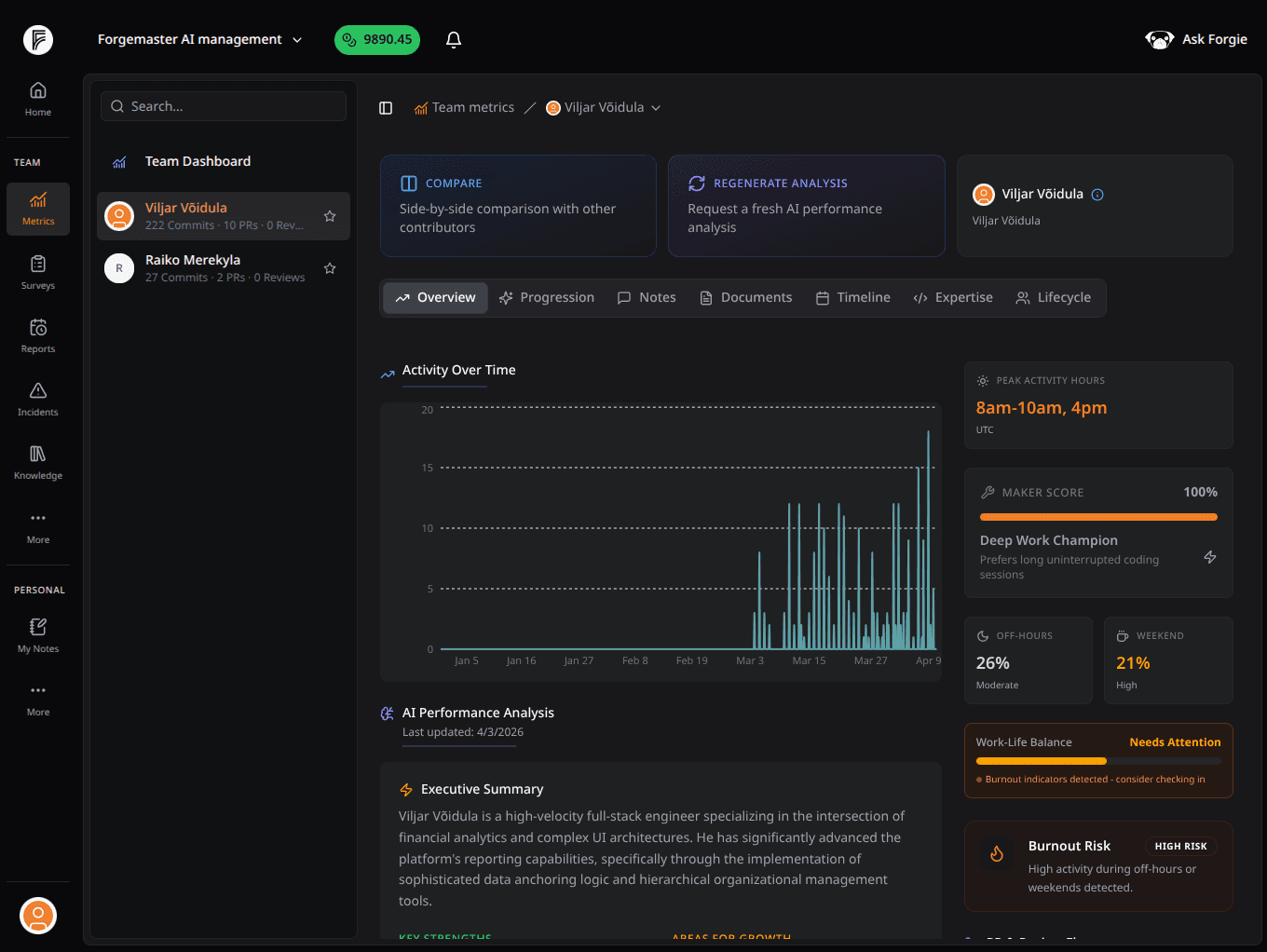
See when contribution shape, focus hours, and review behavior start to signal strain instead of healthy throughput.
Use explicit risk indicators so leadership can distinguish normal intensity from sustained overload.
Carry the signal into prep and recording workflows so the intervention actually happens.
How the cadence runs
The signal matters most when it becomes part of normal leadership follow-through.
Use the weekly review and contributor views to see where intensity, context switching, or off-hours work are climbing.
The emerging risk is visible before it is critical.
Read the signal against incidents, ownership concentration, and role expectations before jumping to conclusions.
The manager has grounded context for the conversation.
Bring the signal into 1:1 prep, adjust load or priorities, and track whether the situation improves.
Support work becomes explicit and trackable.
Screen spotlight
The goal is not to label people, but to show when the system is asking something unhealthy of them.
What changes
That makes the interventions less reactive and more believable to the team.
Signals reach the people responsible for support while the contributor still has room to recover.
1:1s start from actual pattern change instead of vague concern or second-hand observation.
Leadership can connect people strain to delivery, ownership, or resourcing decisions instead of treating it in isolation.
Go deeper
They help you see when the people issue is really a workflow, ownership, or leadership reporting issue too.
Carry it into conversations
02Load manager conversations with context and keep action items tied to follow-through.
Leadership reporting
When leadership updates feel vague, use team and repo signals to explain what changed and what needs support.
Outcome
Deliver engineering updates that hold up to follow-up questions.
Check adjacent risks
02Weekly review pain
When leadership spends the meeting reconstructing the week, use one shared baseline for delivery, incidents, and risk.
Outcome
Review prep drops from 90 minutes to under 20.
Ownership continuity
When critical systems depend on too few people, use repo ownership and depth data to strengthen coverage early.
Outcome
Know which critical systems need healthier shared coverage.
Start with contributor profiles, then carry the signal into manager prep and the weekly review loop around it.