

Manager action
Contributor profiles
When a team signal points to one person, use workload, impact, and ownership context to coach earlier.
Feature spotlight
This page explains how the manager workflow works: what gets pulled into prep, how the conversation stays grounded, and how the outcome remains attached to future action.
Primary job
Manager workflow
the surface that turns product signal into a concrete conversation and next step
Best cadence
Weekly or biweekly
use it whenever managers run a regular contributor rhythm
Decision type
Coaching and support
especially when contributor load or growth needs clearer context
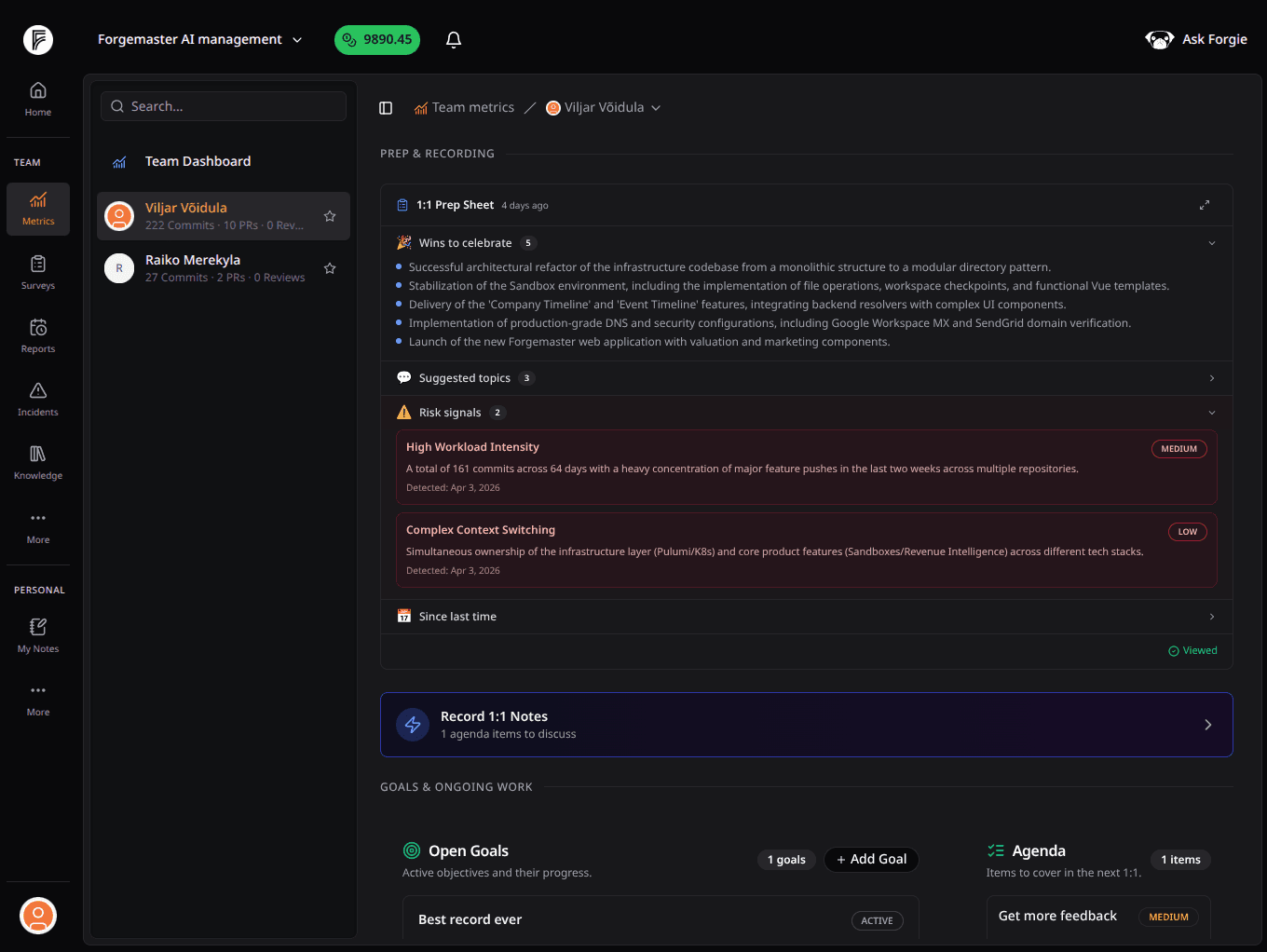

See it in action
From a pre-loaded agenda based on real signals to tracked action items that carry forward — the prep work is done before the meeting starts.
Alex Chen
Tue · 10:00
Priya Rajan
Thu · 14:00
Marcus Webb
Fri · 11:00
Sarah Kim
Fri · 14:00
Daniel Park
Mon · 15:00
What it solves
Without a manager handoff, even strong product signals often stay trapped in dashboards or disappear after the weekly review.
By the time a 1:1 starts, it should already be obvious which patterns, risks, or wins matter most for the conversation.
If action items and outcomes are not recorded in context, the same issues get rediscovered repeatedly.
Leaders need to see whether the same problem is recurring, improving, or shifting into a different category of risk.
What changes
That improves both the quality of the conversation and the likelihood that support work actually lands.
Managers go into 1:1s with a sharper read on what changed instead of generic talking points.
Action items do not disappear after the conversation because the outcome stays tied to the workflow.
Weekly reviews, contributor profiles, and manager notes begin reinforcing each other instead of living in separate systems.
Go deeper
They explain where the prep context comes from and which team-level workflows it should influence in return.
Source the context
02Manager action
When a team signal points to one person, use workload, impact, and ownership context to coach earlier.
People strain
When overload or burnout shows up too late, use work-pattern and retention signals to surface strain earlier.
Outcome
Spot burnout and overload 4–6 weeks before it becomes attrition.
Loop it back into operations
02Turn Friday review prep into one repeatable operating cadence for the whole team.
Ownership continuity
When critical systems depend on too few people, use repo ownership and depth data to strengthen coverage early.
Outcome
Know which critical systems need healthier shared coverage.
Use the contributor profile as the evidence layer, then make prep and recording the mechanism that carries that signal into follow-through.