

Product
See what is slowing delivery, where risk is building, and what to fix next.
Forgemaster pulls GitHub activity, team signals, and ownership data into one operating view so engineering leaders can coach earlier, plan better, and make decisions with less guesswork.

Why teams stay stuck
Engineering data is everywhere, but teams still struggle to see what needs attention.
The data is spread across too many tools
GitHub, boards, and spreadsheets still leave teams without one shared read on what is improving or slipping.
Activity does not explain delivery drag
Pull request volume and throughput help, but they rarely show where interruptions, review friction, or handoff problems begin.
Context arrives after the sprint is off course
When overload or low confidence finally surfaces, the team is already spending review time explaining surprises.
How it solves that
It turns scattered signals into one clearer operating picture.
Use one view to see what changed, why it is happening, and what the next action should be.
One place to see what changed
Delivery flow, review speed, interruptions, and confidence sit in one view, so the team stops stitching the story together by hand.
Weekly reviews start from the same facts.
Signals that point to the likely cause
Instead of just showing that output moved, Forgemaster surfaces where review drag, overload, ownership gaps, or process friction are building.
See the likely cause sooner.
Context for the people side of delivery
Surveys and contributor signals show whether the problem is process, workload, confidence, or a risk concentrated in one person.
Keep metrics and team feedback in one loop.
Where it helps
How Forgemaster helps teams act earlier.
Each part of the product answers a practical question: where work is slowing, who needs support, where ownership is fragile, and whether pay decisions are grounded.
Delivery operations
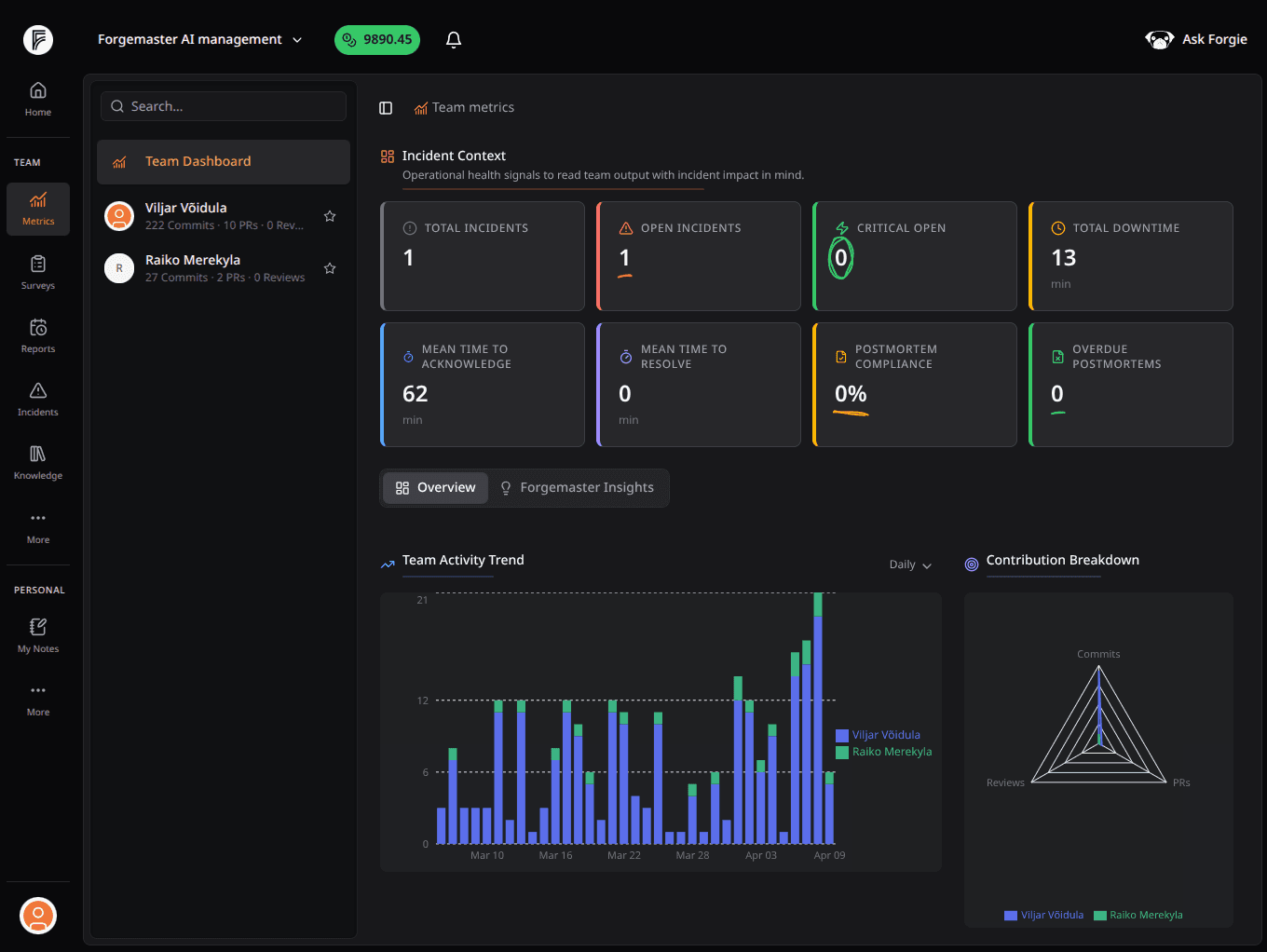
Operational health in one view
Read incident context, activity trend, and contribution mix in one review view.
- Spot downtime and response pressure earlier.
- See who is carrying current demand.
- Use one source in weekly ops reviews.
In practice
What the first useful review looks like.
Team review view
One place to review delivery, risk, and next actions
Review time
11.4h
Down from 18.2h after clearer handoff rules.
Cycle time
3.8d
Stable this week, with checkout and infra changes slowing the tail.
Merged pull requests
42
Healthy throughput without a spike in rework.
Team confidence
74%
Survey confidence improved after last process change.
Signals worth discussing
- Backend reviews are back under the team target for the first time in three weeks.
- Interrupt-driven work is rising on the platform stream and should be discussed in planning.
- The mobile team is shipping consistently, but survey confidence still trails delivery output.
Next step
Ready to see your own team this way?
Start with a self-serve check-in, book a guided demo, or compare plans first.
What this helps you do
- See the delivery story without reconciling separate dashboards.
- Connect movement in the work to the likely team or process cause.
- Leave the review with a clearer next action, not just more numbers.
Team insight feed
- Platform
Interrupt load is masking healthy throughput.
Merge volume looks stable, but repeated context switching is pulling planned work off course.
- Backend
Review speed improved after ownership tightened.
The dashboard shows shorter review time and fewer stalled pull requests after the new reviewer rotation.
- Mobile
Output is steady, confidence still needs attention.
Survey responses point to release anxiety even though throughput remains consistent week to week.
Survey pulse
I know what to focus on this sprint.
81% agree
Reviews are fast enough for my work to keep moving.
67% agree
Interruptions are hurting delivery quality.
54% agree
Onboarding flow
Get to a useful read fast.
Connect GitHub
Connect GitHub without scripts, write access, or pipeline changes.
Read-only setup so the first useful signal shows up quickly.
See the first delivery picture
Forgemaster turns GitHub activity into a readable view of review speed, cycle time, interruptions, and ownership risk.
See where work is slowing before it spreads.
Review the likely causes
Signals are translated into practical talking points for coaching, planning, staffing, and process fixes.
Move from symptoms to the next decision.
Add team context when needed
Launch short surveys when metrics alone do not explain the problem, then track whether the response actually helps.
Keep delivery data and team feedback in the same loop.
See what the first review looks like without connecting anything.
Choose your path
Go from product overview to the exact question you need answered.
Use cases explain the problem, feature spotlights explain the product surface, and workflow pages show how leaders actually run Forgemaster week to week.
Problem-first
Use cases
Start from the operating question: weekly reviews, ownership risk, team health, or executive reporting.
Screen-first
Feature spotlights
See what each product surface actually does, what inputs it needs, and which decision it supports.
Workflow-first
How it works
Follow the practical operating loops for setup, weekly review, and manager follow-through.
People intelligence
Then go deeper on ownership, expertise, and pay.
Once the baseline is clear, leaders can see who carries risk, where coverage is thin, and whether pay matches the market.
Compensation benchmarks
P25 · P50 · P75 by level
Mid Engineer
$128k
$112k - $145k
Senior Engineer
$158k
$138k - $178k
Staff Engineer
$192k
$172k - $215k
Eng Manager
$175k
$155k - $198k
Code ownership map
See where ownership is concentrated and where coverage is shared across the codebase.
Auth & access control
1 contributor
91%
High concentrationPayments & billing
2 contributors
68%
Medium concentrationFrontend components
5 contributors
34%
Low concentrationHigh concentration means one departure can create real delivery risk.
Expertise coverage
Read technology depth by contributor to spot thin coverage before the next handoff or hire.
TypeScript
8 contributors
Go
2 contributors
Terraform
1 contributor
PostgreSQL
4 contributors
Used in compensation view
Ownership and expertise can feed contributor value weights, so pay conversations reflect depth instead of title alone.
Trust & security
Designed for teams handling sensitive engineering data.
Forgemaster uses read-only GitHub access, stores no source code, and avoids unnecessary retention or third-party sharing.
Read-only access, always
GitHub is connected via a read-only OAuth token. Forgemaster cannot modify repositories, trigger workflows, or touch write-protected resources.
OAuth scope: read:org, read:user, repo (read-only)
Self-hosted deployment available
Run Forgemaster entirely within your own infrastructure. Your engineering data stays inside your network — no external ingestion, no third-party data routing.
Docker + Kubernetes — your cloud, your control
Minimal data retention
Only the signals needed to generate your dashboard are kept. No data lakes, no long-term storage of raw activity, no third-party data sharing.
Signals only — no raw payloads stored
FAQ
Common questions before a GitHub connection.
You get a readable delivery picture from GitHub activity: review time, cycle time, pull request flow, and the first signals of drag or concentration risk.
Metrics show what moved. Surveys show why it moved. Together they make slowdowns easier to interpret.
No. Smaller teams often benefit fastest because they rarely have dedicated analytics tooling or engineering analysts.
Not entirely. Forgemaster works alongside existing tools and makes the data easier to interpret, discuss, and act on.
The GitHub connection and first delivery view are designed to be useful in the first session.
With read-only access where possible. No write permissions, pipeline changes, or scripts are required.
P25, P50, and P75 market ranges by career level, engagement type, and compensation model, kept current through validity windows and market-sync inputs.
Forgemaster infers technology focus from commit history and maps it to the codebase areas each contributor touches most, so thin coverage is easy to spot.
Code ownership shows how much of an area each contributor has authored and maintained. It matters because a single-owner critical system is a succession and retention risk.