
About Forgemaster

We built Forgemaster because engineering keeps getting misread.

Founders, CTOs, and investors keep making hard calls about engineering with partial evidence. We wanted a way to read the work more honestly: what changed, who carries the risk, where delivery is slipping, and what the team actually needs next.

Built for

FoundersCTOs and engineering leadersInvestors and diligence teams

The questions we kept hearing

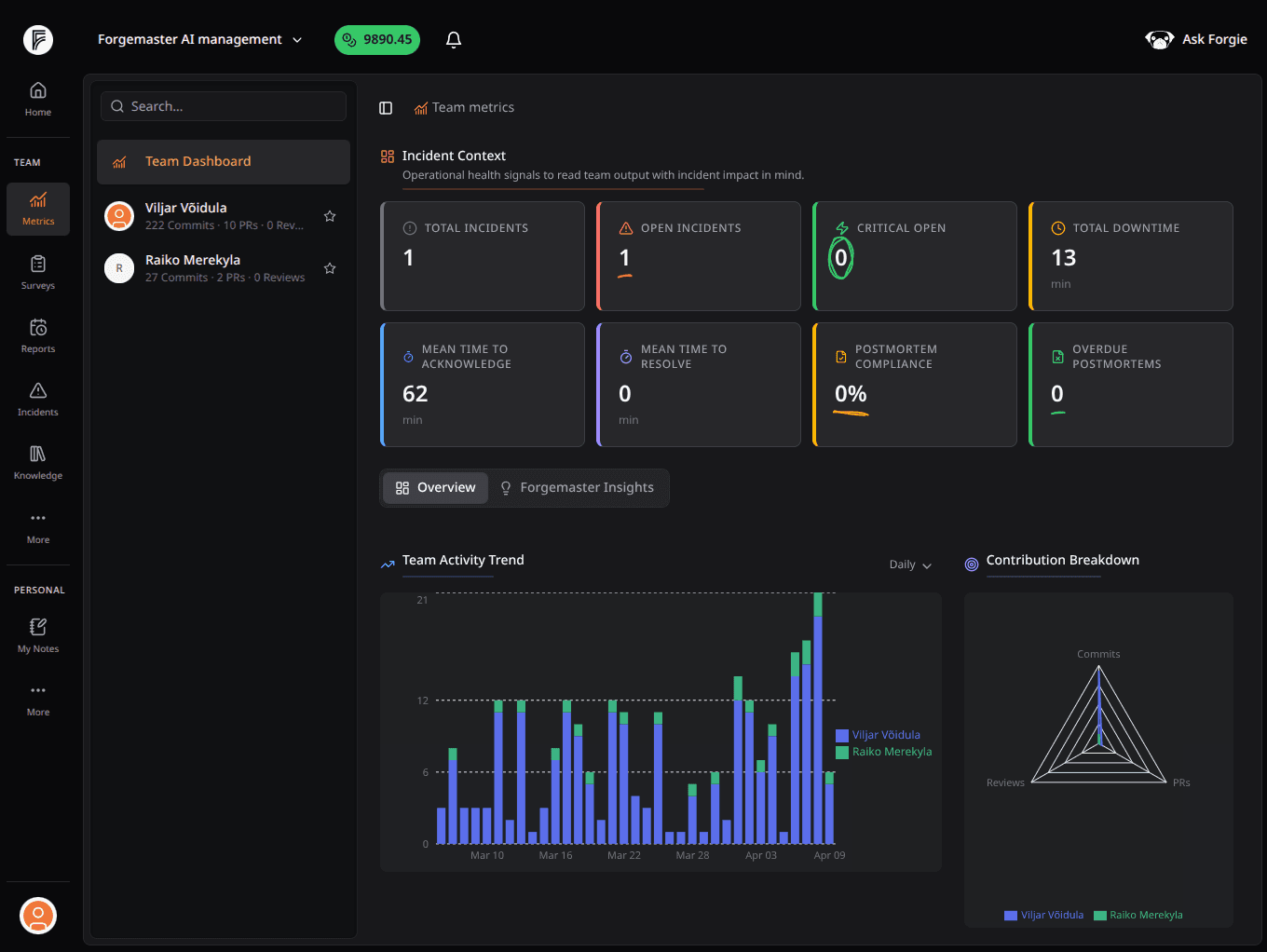
Forgemaster dashboard showing delivery signals, contributor trends, and engineering context

Not "is the team busy?". The real questions.

Again and again, the same conversations surfaced. Different companies, same blind spot.

What is this codebase actually worth?
Where is delivery risk building right now?
What breaks if one person leaves?

The story

The product started with a simple frustration: everyone had data, nobody had a readable picture.

HiringDue diligenceDelivery

What had to change

Replace proxy judgments with evidence people can actually use.

Not another activity dashboard. Not another score that strips out context. A better way to see the work, explain the risk, and act before the damage is obvious.

We kept seeing engineering reduced to proxies. Hiring decisions made from resumes and gut feel. Acquisition calls where repository access changed hands but understanding never did. Leadership conversations stuck between vague optimism and vanity metrics.

The underlying problem was not a lack of information. Git histories, review patterns, ownership clues, and operational signals were already there. They were just scattered across tools, hard to interpret, and impossible to explain to the people who had to make decisions.

Forgemaster is our answer to that. A way to turn engineering work into something legible enough for serious decisions without flattening the nuance that makes software teams human.

"The data was already there. The shared language was not."

That is the standard we still hold ourselves to.

What kept repeating

Three places engineering gets misunderstood.

These are the conversations that shaped the product and the values behind it.

Hiring

Strong engineers kept getting flattened into vague signals.

Resumes and interview performances rarely explained how someone actually worked inside a real codebase.

Due diligence

Repository access was confused with repository understanding.

Buyers could inspect the repo, but still leave without a clear read on delivery health, concentration risk, or long-term resilience.

Leadership

Teams were being judged by output theater instead of operating reality.

Pull request counts and noise do not explain overload, review drag, brittle ownership, or why a team suddenly feels slower.
What we believe

Three principles we refuse to drop.

Forgemaster only works if the product stays faithful to the values underneath it.

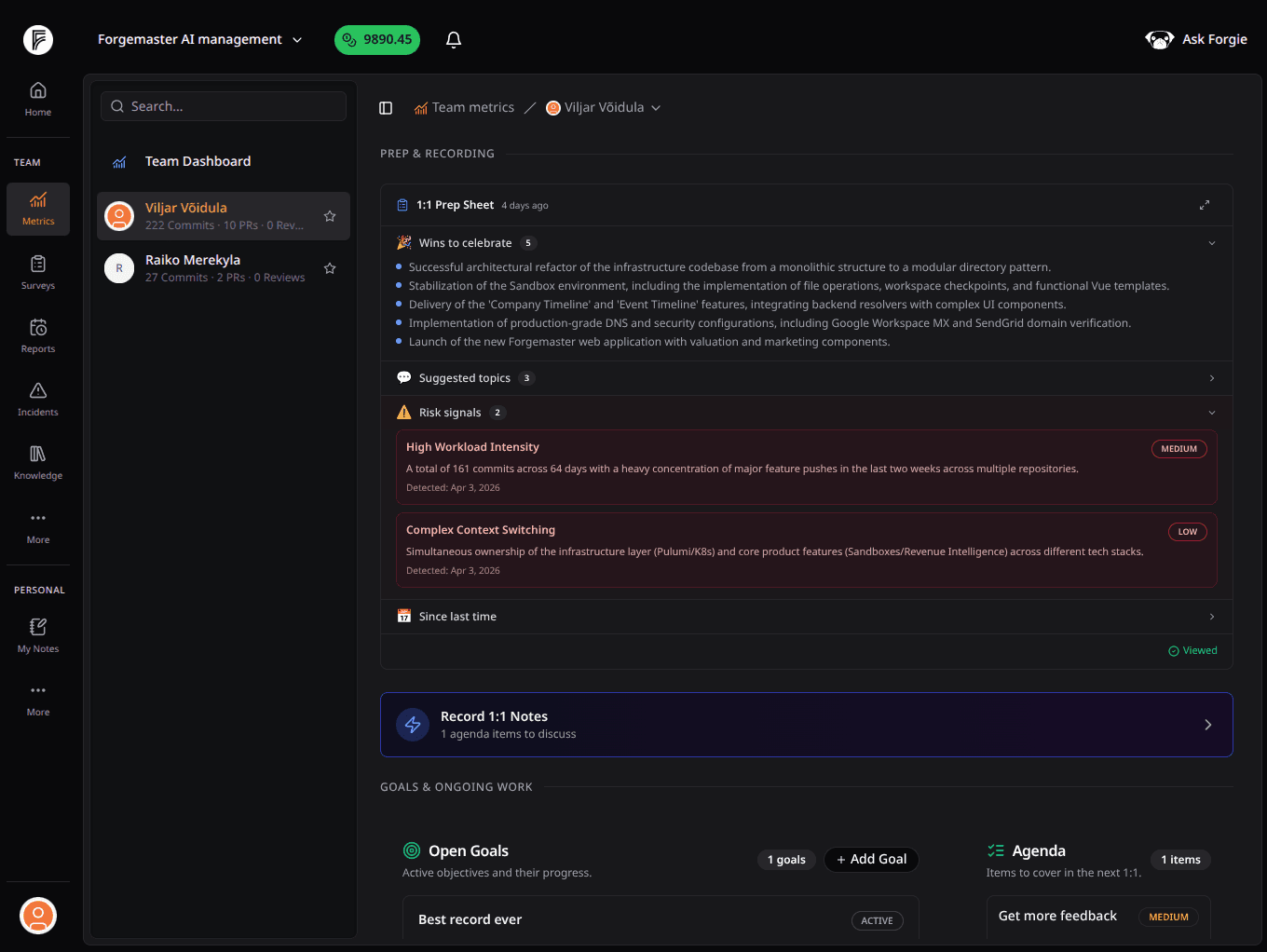
Forgemaster contributor insights screen with focus, risk, and suggested coaching topics

How that shows up

The product is meant to make engineering legible without turning teams into a scoreboard.

The interface is intentionally built for decision-makers and operators at the same time: readable enough for board conversations, grounded enough for the people doing the work.

Signals that point to delivery drag before it becomes a missed commitment.
Contributor context that helps managers prepare better conversations, not harsher surveillance.
Ownership views that surface fragility before one resignation becomes an emergency.

Evidence over performance.

We care about observable work patterns, not productivity theater. The goal is a picture you can defend in a serious room.

In practice

We read review flow, ownership, activity concentration, and delivery movement instead of chasing vanity metrics.

Context stays attached.

A number without its surrounding conditions is easy to weaponize. We want the explanation next to the signal.

In practice

Signals are framed with recent changes, workload shape, and team dynamics so decisions do not drift into guesswork.

Privacy is part of the product, not a legal footnote.

Engineering data is sensitive. Access has to be earned, limited, and handled with restraint from the start.

In practice

Read-only GitHub access, no source code storage, and a low-retention posture are baseline design choices, not upsells.

Who is building it

A small team with very specific obsessions.

We care about making engineering easier to understand without sanding off the truth.

Founder & CXO

Viljar Võidula

Staff engineer, interim CTO, and CEO of Testreel. Has spent years translating technical reality for people who still need to make business calls.

Focus

Turning engineering signals into decision language leaders can actually use.

Founding Frontend Engineer

Raiko Mereküla

Founding frontend engineer focused on making dense technical information feel immediate, calm, and usable.

Focus

Designing interfaces that help people understand complex engineering reality quickly.

Founding Designer

Maris Lutsar

Founding designer shaping the structure, language, and trust layer around the product.

Focus

Making the product feel rigorous, clear, and trustworthy before anyone clicks a second screen.

If your engineering story is still mostly guesswork, we should fix that.

We will show you what the codebase is saying, where the team is carrying hidden risk, and how to make the next decision with more confidence.

Read-only access. Human judgment stays in the loop.