

Engineering leadership problems

Fix the blind spots that make weekly engineering reviews slow, reactive, and full of guesswork.

If delivery status lives across five tools, people risk shows up too late, and ownership problems surface only during incidents, these pages show how Forgemaster closes those gaps and helps leaders act sooner.

  • Stop rebuilding the weekly review from Jira, GitHub, incident threads, and manager memory.
  • Catch burnout, ownership concentration, and delivery drag before they become attrition or outages.
  • Give managers and leadership one evidence base for coaching, planning, and compensation decisions.

No credit card required · Read-only access · Setup in <15 min

Core problem

No shared baseline

leadership and managers walk into review with different stories about what happened

Typical failure

Late intervention

people, repo, and retention issues surface only after the damage is visible

What changes

Faster action

each route shows how to spot the problem sooner and decide what to do next

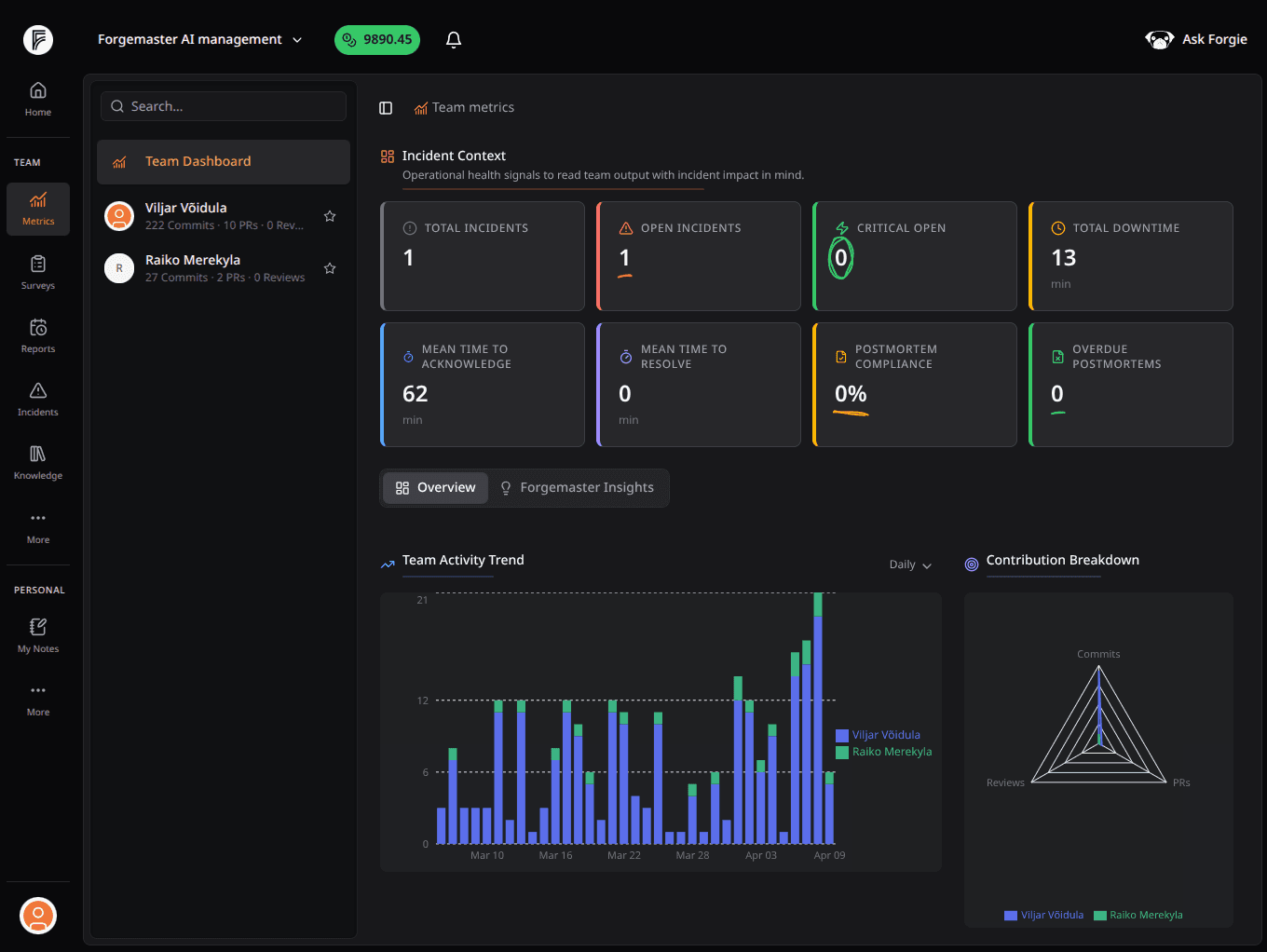
Forgemaster team metrics dashboard preview
Laptop frame

Built for engineering leaders at 10–500 person teams

Read-only accessSOC2-aligned practicesSetup in <15 min

Before vs. after

What changes when your team operates from one baseline.

Without Forgemaster

  • Weekly review prep takes 60–90 minutes stitching Jira, GitHub, and Slack updates.
  • People risks — burnout, disengagement, ownership concentration — surface weeks after damage is done.
  • Compensation and performance decisions rely on recency bias and whoever speaks loudest.
  • Leadership and managers walk into review with different stories about what happened.

With Forgemaster

  • Review prep takes 18 minutes from one shared dashboard everyone trusts.
  • Contributor signals and workload patterns surface strain 4–6 weeks before it becomes visible.
  • Compensation decisions draw on contribution depth, market context, and retention risk in one view.
  • Leadership, managers, and reviewers start every meeting from the same evidence base.

Real results

What engineering teams measure after adopting Forgemaster.

90 min

before Forgemaster

18 min

review prep time

more 1:1 context per manager

vs. relying on memory or recent anecdotes alone

20–30 min

hunting notes before

< 5 min

to full contributor context

exit interview

was previously first sign

4–6 wks

earlier risk signal

Your first 30 days

How teams go from setup to operating from one source of truth.

1

Day 1

Connect your data

Link GitHub, Jira, and incident tools in under 15 minutes. Read-only access — no code changes, no risk.

2

Week 1

Run your first weekly review

Open the team dashboard before your next review meeting. Cut prep time and start from a shared baseline everyone can see.

3

Day 30

Team operates from one source of truth

Managers prep 1:1s from contributor profiles. Leadership spots risk early. Decisions draw on evidence, not anecdote.

Fix the weekly review

When leadership lacks one trustworthy baseline, start here.

These are the routes for teams tired of stitching together weekly status from multiple tools and conflicting narratives.

90 min

before

18 min

review prep

Shared review surface

Team metrics dashboard

See the state of delivery, incidents, work distribution, and contribution movement in one place before the weekly review begins.

Decision unlocked

Know which team, repo, or trend needs attention this week.

  • Combines delivery, incidents, contribution flow, and emerging risk in a single weekly baseline.
  • Creates one starting point for leadership, managers, and reviewers instead of dueling reports.

Who it serves: VP engineering, directors, and managers running the team review

more context per 1:1

vs. relying on memory or recent anecdotes

Coaching and growth

Contributor profiles

Open a person-level view with impact, workload shape, ownership footprint, and growth signals before a 1:1 or calibration discussion.

Decision unlocked

Coach from evidence instead of recent anecdotes.

  • Shows contribution patterns, ownership exposure, and change over time per person.
  • Connects performance context to real work signals without flattening people into one score.

Who it serves: Managers, skip-level leaders, and people partners

< 5 min

to full contributor context

vs. 20–30 min hunting notes

Manager follow-through

1:1 prep and recording

Walk into every 1:1 with the recent signals already summarized, then capture actions where the coaching context lives.

Decision unlocked

Turn weekly signals into tracked follow-through.

  • Prepares managers with context before the meeting instead of after the fact.
  • Keeps notes, talking points, and actions connected so commitments do not disappear.

Who it serves: Managers running recurring contributor conversations

Find root cause and act

When something looks off, use these routes to find the real problem and respond earlier.

They help you move from a vague signal to the person, repository, retention, or rollout issue behind it.

3 tools

before

1 screen

ownership, health & risk

Ownership and technical drag

Repository impact

Compare repo health, ownership concentration, and technical friction to find the systems creating risk underneath the team metrics.

Decision unlocked

See which codebase areas need de-risking before the next incident or handoff failure.

  • Highlights brittle ownership, thin contributor coverage, and concentration around critical systems.
  • Helps separate normal delivery variance from structural codebase risk.

Who it serves: Engineering leaders, staff engineers, and platform owners

gut feel

before

1 view

impact + market + retention

Reward and retention

Compensation benchmarking

Link market context with actual impact so compensation conversations start from contribution, coverage, and retention risk instead of gut feel.

Decision unlocked

Make reward decisions with market context and engineering reality in the same view.

  • Places contributor impact next to pay context and retention pressure.
  • Supports harder decisions around leveling, equity, and intervention timing.

Who it serves: Leaders making calibration, promotion, or retention calls

exit interview

was first sign

4–6 wks

earlier risk signal

Work patterns

Contribution activity log

When someone's output shifts or a critical area goes quiet, use weekly contribution trends to see what changed, when it changed, and who was involved.

Decision unlocked

Spot disengagement and overload before the exit interview.

  • Shows contribution frequency, review activity, and work shape week over week per person.
  • Flags when a high-impact contributor goes quiet or changes their usual work pattern.

Who it serves: Engineering managers and skip-level leaders

Common questions

Answers to what engineering leaders ask before buying.

Is my code or source data ever exposed?

No. Forgemaster uses read-only API access to GitHub, Jira, and your incident tools. We never store source code, diffs, or file contents — only metadata like commit counts, PR cycle times, and ticket throughput.

How long does setup actually take?

Most teams are connected and running their first weekly review within 15 minutes. There are no agents to install, no code changes required, and no lengthy security reviews for read-only API tokens.

Who is Forgemaster built for?

Engineering leaders — VPs, directors, and senior managers — at companies with 10 to 500 engineers. It's especially useful for teams where the weekly review ritual is either broken, missing, or takes too long.

What does pricing look like?

Pricing is based on team size. You can start with a free audit to see what Forgemaster would surface for your team, then book a walkthrough to discuss the right plan. No contract required to get started.

What happens to my data if we cancel?

All your data is deleted within 30 days of cancellation. We don't retain team metrics, contributor data, or account information after the relationship ends.

Does it integrate with tools we already use?

Forgemaster connects to GitHub, GitLab, Jira, Linear, PagerDuty, and other common engineering tools. If you use a tool not on the list, book a walkthrough and we'll confirm compatibility before you sign up.

See exactly how Forgemaster closes the gaps your current tools leave open.

Book a 30-minute walkthrough — we'll map the specific route from your weekly review pain to contributor follow-through, repository risk, and compensation decisions your team needs now.

No credit card requiredRead-only accessCancel anytime