

Manager action
Contributor profiles
When a team signal points to one person, use workload, impact, and ownership context to coach earlier.
Feature spotlight
This page is for leaders who want a more evidence-backed way to talk about compensation than title, tenure, or manager intuition alone.
Primary job
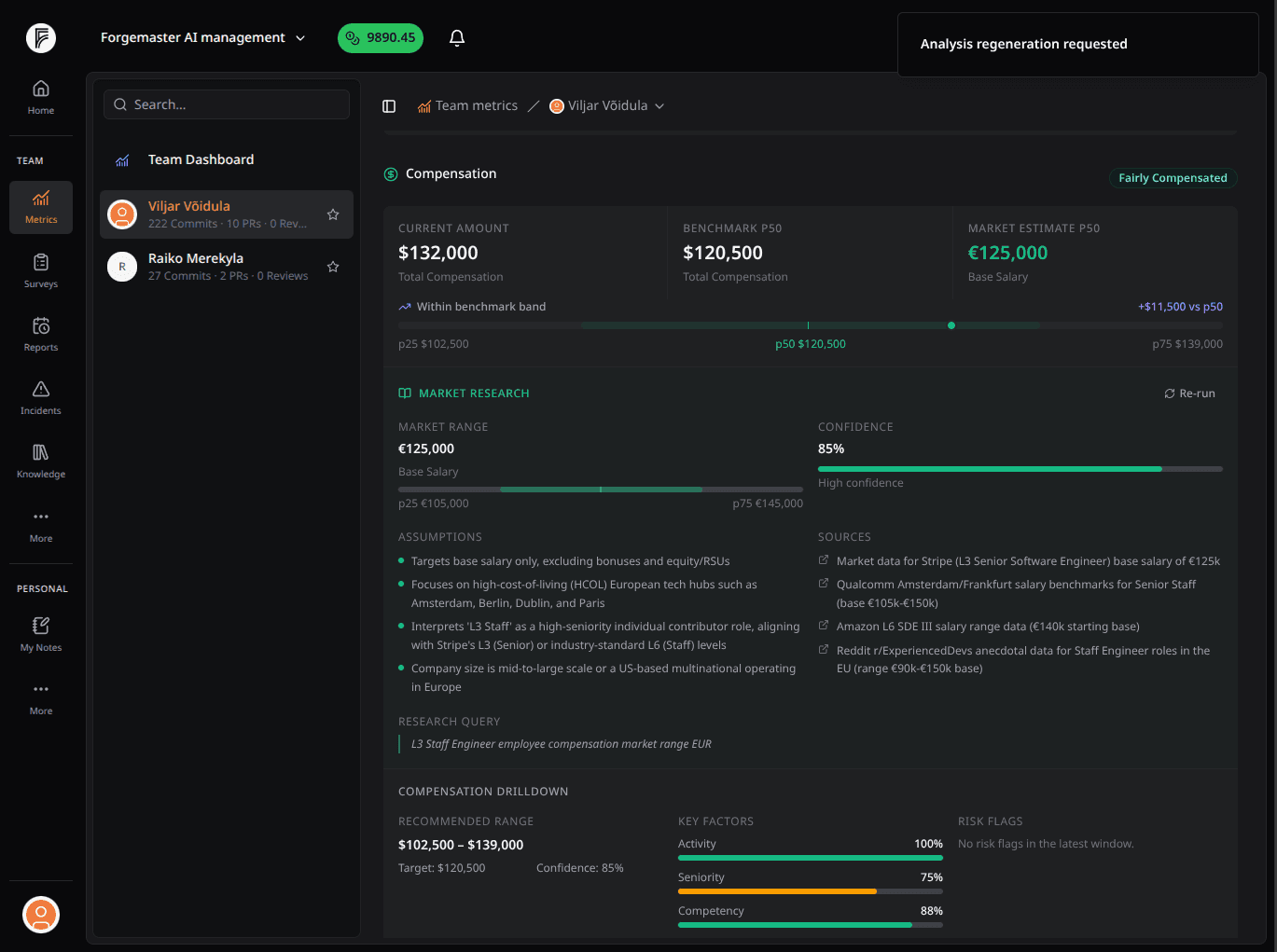
Pay context
the screen helps frame a compensation conversation instead of pretending to automate it
Best cadence
Quarterly
use it in review cycles, retention checks, and adjustment planning
Decision type
Retention and equity
especially when contributor depth is carrying disproportionate org value

See it in action
Market data overlaid on your team's comp in seconds — spot the gaps, get the recommendation, and schedule the conversation before someone else does.
Engineer
Role · Level
Current
Alex Chen
L5
$178k
Priya Rajan
L4
$145k
Marcus Webb
L6
$212k
Sarah Kim
L4
$138k
Daniel Park
L3
$120k
What it solves
This feature gives leadership a way to bring market context and actual contributor depth into the same frame.
External compensation data is useful, but only when it is interpreted against the actual role the person is playing in the org.
A contributor can be carrying deep platform, ownership, or review leadership value that title alone does not capture.
When high-value contributors are out of band against both market and internal reliance, the risk is rarely just financial.
What changes
That improves both fairness and retention decision quality.
Leadership can explain why a compensation conversation is happening and what evidence is driving it.
The team can identify when a high-impact contributor is drifting into a real compensation risk zone.
Finance, leadership, and managers can work from the same context instead of separate assumptions.
Go deeper
They show the contributor context underneath the compensation conversation.
Read the person clearly
02Manager action
When a team signal points to one person, use workload, impact, and ownership context to coach earlier.
People strain
When overload or burnout shows up too late, use work-pattern and retention signals to surface strain earlier.
Outcome
Spot burnout and overload 4–6 weeks before it becomes attrition.
Use the contributor and team-health views to build the context first, then let compensation benchmarking frame the decision.