

Ownership continuity
Ownership and knowledge continuity
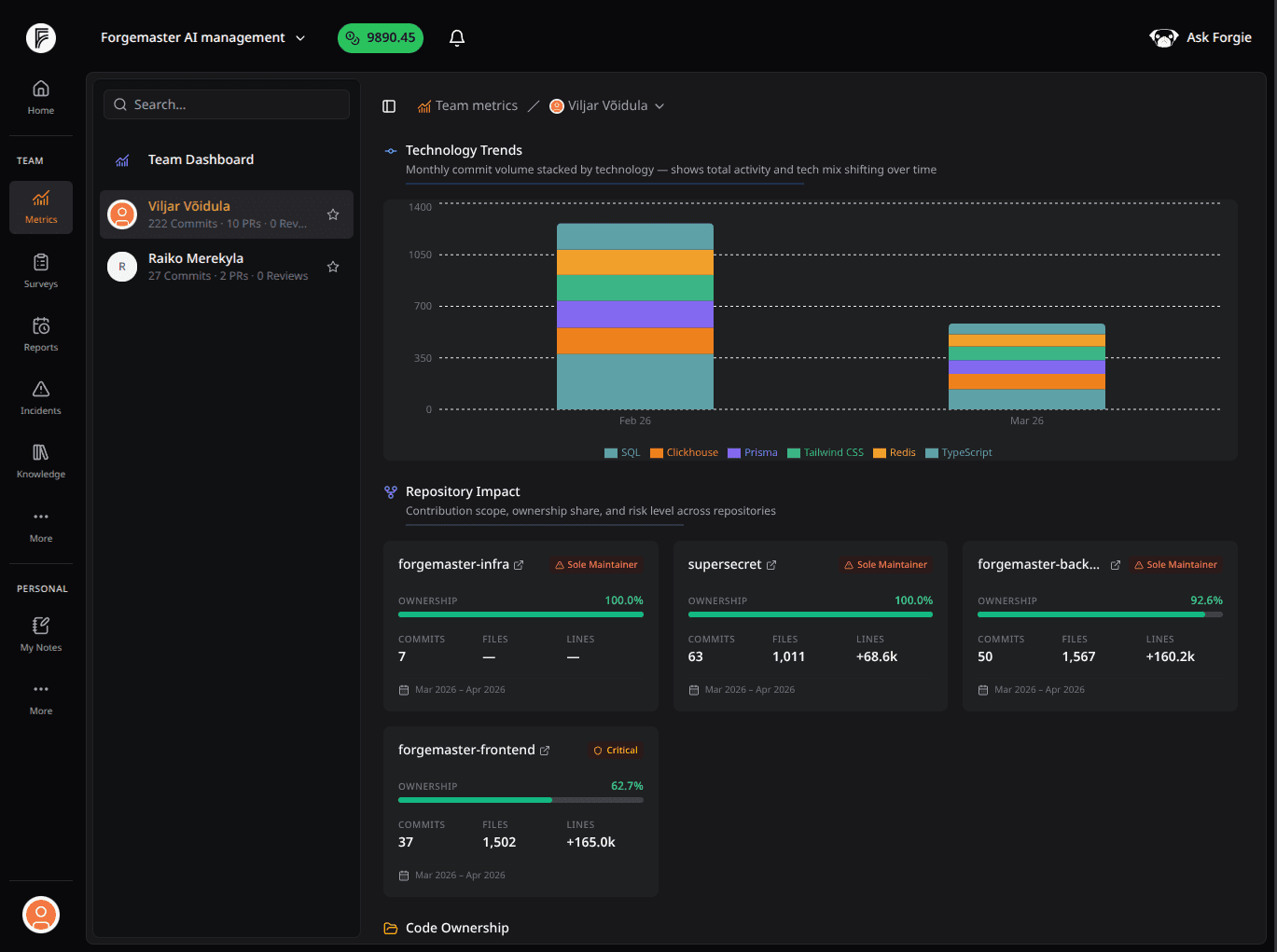
When critical systems depend on too few people, use repo ownership and depth data to strengthen coverage early.
Outcome
Know which critical systems need healthier shared coverage.
Feature spotlight
This page is for leaders who need to understand which repositories are becoming harder to maintain, where ownership is concentrated, and how that context connects to delivery.
Primary job
Repo triage
the fastest way to see where technical and ownership risk is accumulating
Best cadence
Monthly
review it with roadmap, maintenance, and resilience planning
Decision type
Where to invest
helps leadership choose what to fix, transfer, or staff next
See it in action
Scan the portfolio, identify the brittle repos, and walk into the next leadership meeting with a clear risk brief — not a spreadsheet.
Repository
Lang
Contrib.
Score
payments-service
1
32
api-gateway
4
61
auth-core
2
58
frontend-app
6
84
data-pipeline
3
77
What it solves
This screen turns the codebase into something that can be discussed as a portfolio of health, risk, and dependency.
One or two unhealthy repos can quietly slow the wider org without showing up clearly in team-level metrics alone.
A repo can keep moving while becoming more and more dependent on a single maintainer or expert.
Without a repo-level read, maintenance and refactor work compete poorly against headline feature delivery.
What changes
That improves both maintenance quality and leadership clarity.
The team can choose which systems to refactor, stabilize, or transfer with less argument and more evidence.
Ownership concentration is visible before the repo becomes a single-person operational liability.
Leadership can explain why a repo needs investment without relying on hand-wavy technical language.
Go deeper
They help you interpret whether the repo problem is mostly technical, organizational, or both.
Check the human side
02Ownership continuity
When critical systems depend on too few people, use repo ownership and depth data to strengthen coverage early.
Outcome
Know which critical systems need healthier shared coverage.
Manager action
When a team signal points to one person, use workload, impact, and ownership context to coach earlier.
Connect it to the operating loop
02Start with repository impact, then branch into ownership or the weekly operating loop to decide what should happen next.