

Weekly review pain
Weekly engineering review
When leadership spends the meeting reconstructing the week, use one shared baseline for delivery, incidents, and risk.
Outcome
Review prep drops from 90 minutes to under 20.
Use case
This page is for the CTO or engineering leader who needs to explain what changed, what is at risk, and how confident the organization should feel about the next stretch of execution.
Best cadence
Monthly
or whenever leadership needs a structured update on engineering movement
Primary audience
CTO + exec team
especially board, founder, or investor conversations
Primary outcome
Better narrative
less vague reporting and more confidence-backed explanation
Problem framing
Leadership does not just need metrics. It needs a believable interpretation of what those metrics mean for delivery, resilience, and team health.
Without context, engineering reporting becomes either vanity output or defensive explanation.
Technical health, incident pressure, and people strain rarely live in one update stream.
Leadership often hears what changed, but not how worried it should actually be.
What Forgemaster surfaces
That is what keeps the narrative grounded instead of ornamental.
Use the team dashboard to explain delivery movement, incident pressure, and the main changes in engineering output.
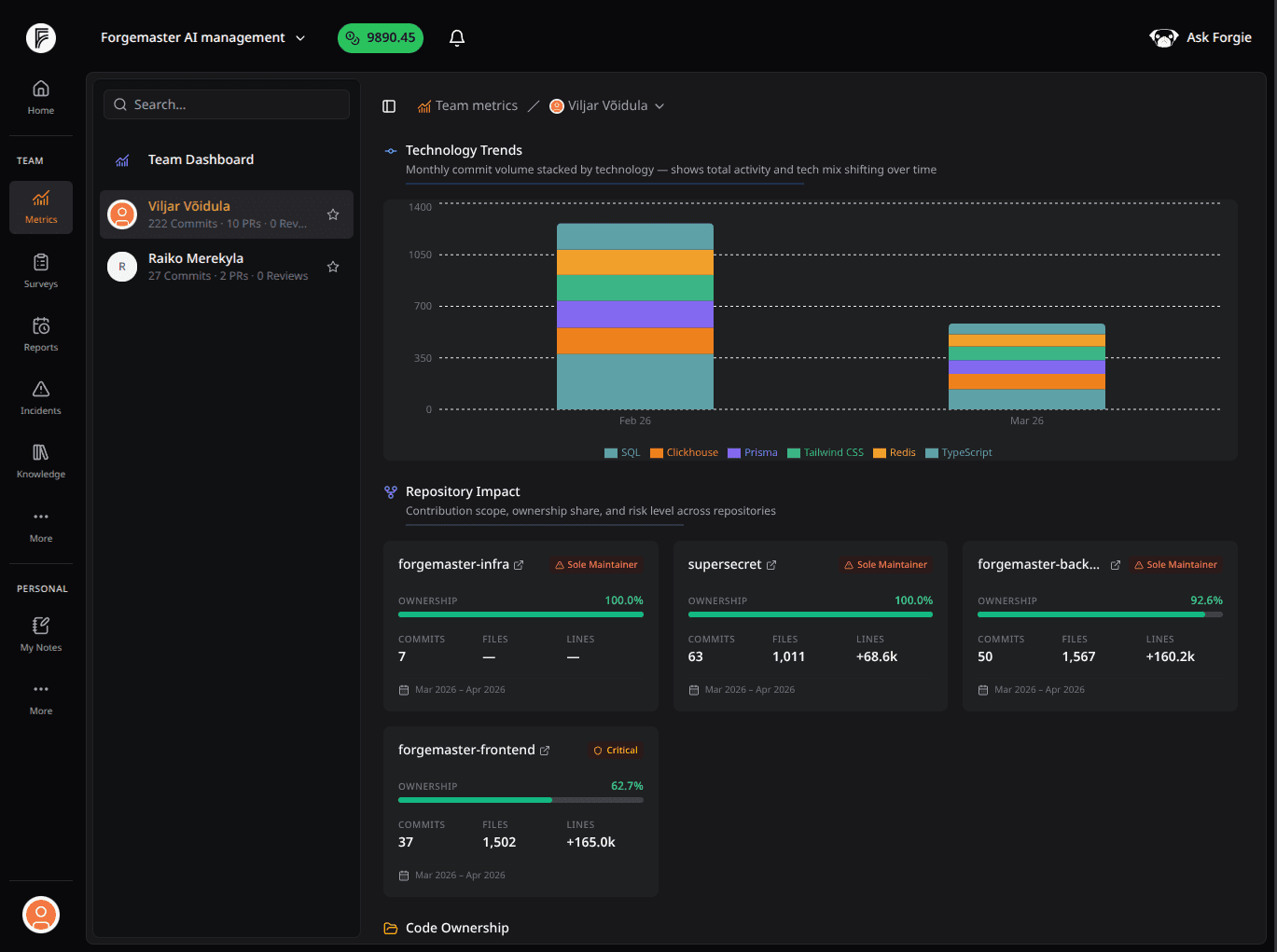
Use repository and ownership views to show whether the system underneath that output is becoming stronger or more brittle.
Use contributor and health views when leadership needs to understand whether team strain is entering the picture.
How the cadence runs
That keeps leadership review honest and reduces narrative drift between the org and the board.
Start from the team dashboard and weekly review material so the briefing reflects what engineering already knows to be true.
The briefing starts from shared facts.
Use repository, ownership, and contributor surfaces to explain whether the movement is healthy, fragile, or under strain.
Leadership gets a grounded interpretation, not just a metric dump.
Walk leadership through what changed, what matters, and what deserves attention next.
The executive conversation improves.
Screen spotlight
They let leadership show where the movement comes from and how stable the system underneath it really is.
What changes
That helps both leadership quality and organizational trust.
Leadership can explain engineering movement with concrete signals instead of generic confidence language.
The org can bring up delivery or resilience risk while it is still manageable, not only after it lands.
The briefing shifts from status recital toward discussion of tradeoffs, confidence, and strategic support.
Go deeper
They supply the operational, technical, and resilience context that leadership reporting usually lacks.
Build the baseline
02Weekly review pain
When leadership spends the meeting reconstructing the week, use one shared baseline for delivery, incidents, and risk.
Outcome
Review prep drops from 90 minutes to under 20.
People strain
When overload or burnout shows up too late, use work-pattern and retention signals to surface strain earlier.
Outcome
Spot burnout and overload 4–6 weeks before it becomes attrition.
Add the risk context
02Repo clarity
When delivery drag keeps repeating, compare repo health, ownership concentration, and technical friction to find the cause.
Ownership continuity
When critical systems depend on too few people, use repo ownership and depth data to strengthen coverage early.
Outcome
Know which critical systems need healthier shared coverage.
Start from the weekly baseline, then layer in repository and org risk until the narrative is clear enough to defend upward.