

People strain
Team health and burnout signals
When overload or burnout shows up too late, use work-pattern and retention signals to surface strain earlier.
Outcome
Spot burnout and overload 4–6 weeks before it becomes attrition.
Use case
This page is for the leader who suspects too much of the system lives in too few heads and wants a practical way to understand it, explain it, and improve coverage.
Best cadence
Monthly
review this alongside roadmap, staffing, and maintenance planning
Primary audience
CTO + staff leads
especially teams managing legacy systems or concentrated platform knowledge
Primary outcome
Stronger coverage
fewer hidden dependencies on single people or single repos
Problem framing
The work keeps shipping, so leadership assumes the system is covered. Forgemaster helps teams see where shared context would make delivery steadier.
Teams know who the experts are, but not always how concentrated their actual ownership has become.
A repo can feel shared while one person still carries the real maintenance and context burden.
Without a concrete map of concentration, knowledge-sharing stays aspirational instead of operational.
What Forgemaster surfaces
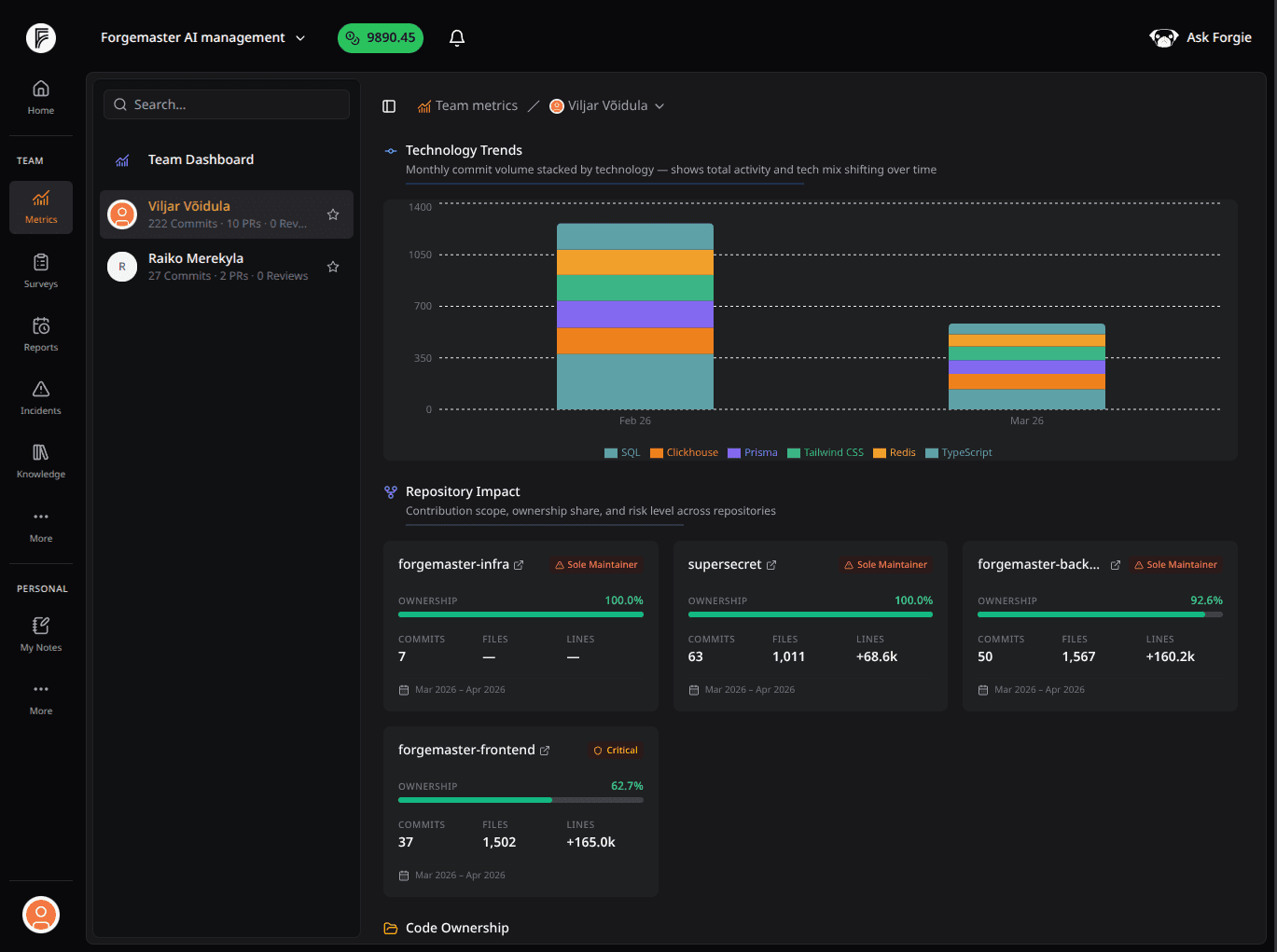
You can see where concentration lives and how it overlaps with the rest of the engineering system.
See which repositories or code areas depend on a narrow set of maintainers to stay healthy.
See where one person owns too much of the system or where their depth is carrying disproportionate risk.
Use contributor and workflow pages to see whether the same people also show up in health, review, or compensation risk.
How the cadence runs
The goal is not just to identify concentration, but to improve shared coverage visibly.
Use the repo and contributor views to identify where knowledge concentration most needs shared coverage.
The concentrated parts of the system are visible.
Pick the repos, code areas, or people that create the highest operational or succession risk.
Transfer work is scoped instead of vague.
Use weekly reviews and manager workflows to make knowledge distribution part of real planning and coaching work.
Coverage improves over time instead of staying hidden.
Screen spotlight
It gives leadership a way to point to the exact system areas that are too dependent on one maintainer or one expert.
What changes
That changes both staffing quality and delivery resilience.
Leadership can name the riskiest areas of the codebase instead of finding them during an outage or resignation.
Knowledge-sharing work can be prioritized where it reduces the most real risk.
The team can make staffing, compensation, and coaching calls with the actual ownership map in view.
Go deeper
Use them when the concentration problem overlaps with people strain or repo-level technical drag.
Check the people context
02People strain
When overload or burnout shows up too late, use work-pattern and retention signals to surface strain earlier.
Outcome
Spot burnout and overload 4–6 weeks before it becomes attrition.
Load manager conversations with context and keep action items tied to follow-through.
Carry it into the operating rhythm
02Weekly review pain
When leadership spends the meeting reconstructing the week, use one shared baseline for delivery, incidents, and risk.
Outcome
Review prep drops from 90 minutes to under 20.
Repo clarity
When delivery drag keeps repeating, compare repo health, ownership concentration, and technical friction to find the cause.
Start the check-in, then use the repository and contributor views to choose which transfer problems matter first.