From the outside, most software teams look healthier than they really are.
Commits are landing. Pull requests are moving. Standups happen. The roadmap still has dates attached to it. But if you are a CTO, founder, engineering manager, or project owner, the uncomfortable question is usually deeper than the dashboard suggests:
Is the team actually healthy, and is the codebase actually in good shape?
Those questions are related, but they are not the same question.
Forgemaster and StackGrit both sit in the broader engineering intelligence platform category. Both help leaders understand software work without reading every pull request or asking engineers for another status report.
But they look at different layers of the software organization.
Forgemaster reads the team.
StackGrit reads the codebase.
That distinction matters. If you blur the two, you can easily pick the wrong tool or expect one product to answer questions it was never designed to answer.
What Forgemaster does
Forgemaster turns engineering activity into operational signals about the team.
It looks at patterns around commits, pull requests, reviews, incidents, delivery rhythm, contributor activity, and team-level movement. The goal is not to inspect every line of code. The goal is to help leaders understand whether the engineering organization is operating in a healthy, sustainable way.
Forgemaster is useful for questions like:
- Are reviews slowing down?
- Is work concentrated around one or two people?
- Are contributors showing signs of overload?
- Are incidents becoming more frequent or taking longer to resolve?
- Is the team delivering at a stable rhythm?
- Is leadership seeing risks early enough to act?
The output is a live operational view. Forgemaster is built for continuous monitoring, not one-off inspection. If you want to see that shape of product, start with the burnout risk demo, the delivery slowdown demo, or the contractor time control demo.
That makes it especially useful when a leadership team wants to understand the health of the engineering system around the codebase: team load, contribution balance, review flow, incident response, and delivery rhythm.
For the people side specifically, the burnout risk story and investor due diligence story show the kinds of questions Forgemaster is built around.
The mental model is:
How is the engineering team performing, and where are the human or operational risks?
Forgemaster treats engineering as an ongoing operating system. It watches motion over time.
What StackGrit does
StackGrit takes a different angle. It analyzes the codebase itself and turns that analysis into a plain-language project health report.
Its positioning is direct: "Your codebase analyzed by AI, explained for humans."
Instead of focusing primarily on weekly team rhythm, StackGrit looks at the asset being produced: the repository, architecture, dependencies, test coverage, quality patterns, security risks, and ownership signals visible in the code and git history.
According to the StackGrit features page, the product is built around health scorecards, plain-language insights, an AI chatbot, team and organization workspaces, progress tracking, and shareable reports. The first analysis is free, and the product is designed so founders, agencies, project owners, and engineering managers can understand a codebase without reading it line by line.
StackGrit is useful for questions like:
- Is this codebase maintainable?
- Are there security risks or outdated dependencies?
- Where are the complexity hotspots?
- Which modules have weak or missing tests?
- Is ownership too concentrated?
- What should be fixed first?
- Can a non-technical stakeholder understand the project risk?
The output is closer to a consultant-style audit than an operations dashboard. It gives grades, findings, recommendations, and plain-language explanations.
The mental model is:
What is the actual condition of this codebase?
StackGrit treats the codebase like an asset that should be inspected, understood, and tracked over time.
Side-by-side comparison
| Category | Forgemaster | StackGrit |
|---|---|---|
| Primary question | How is the team performing? | What condition is the codebase in? |
| Main input | Git activity, PRs, reviews, incidents, contributor patterns | Source code, dependencies, git history, repository structure |
| Output | Live dashboard and leadership digests | On-demand AI codebase health report |
| Cadence | Continuous monitoring | Periodic or on-demand analysis |
| Best for | Team health, delivery rhythm, operational risk | Code quality, architecture, security, technical debt |
| People signals | Burnout indicators, workload concentration, contribution patterns | Knowledge ownership, bus factor, contributor expertise by subsystem |
| Code-level analysis | Indirect, through activity and workflow patterns | Direct, through repository analysis |
| Buyer | CTOs, founders, engineering managers | CTOs, founders, project owners, agencies, non-technical stakeholders |
| Pricing entry point | Starter at 99€/month with free starter credits; Growth at 199€/month; Enterprise custom | Starter at 29€/month, first analysis free |
| Setup | Connect engineering data sources and monitor continuously | Connect or upload a repository and run an analysis |
What Forgemaster catches that StackGrit does not
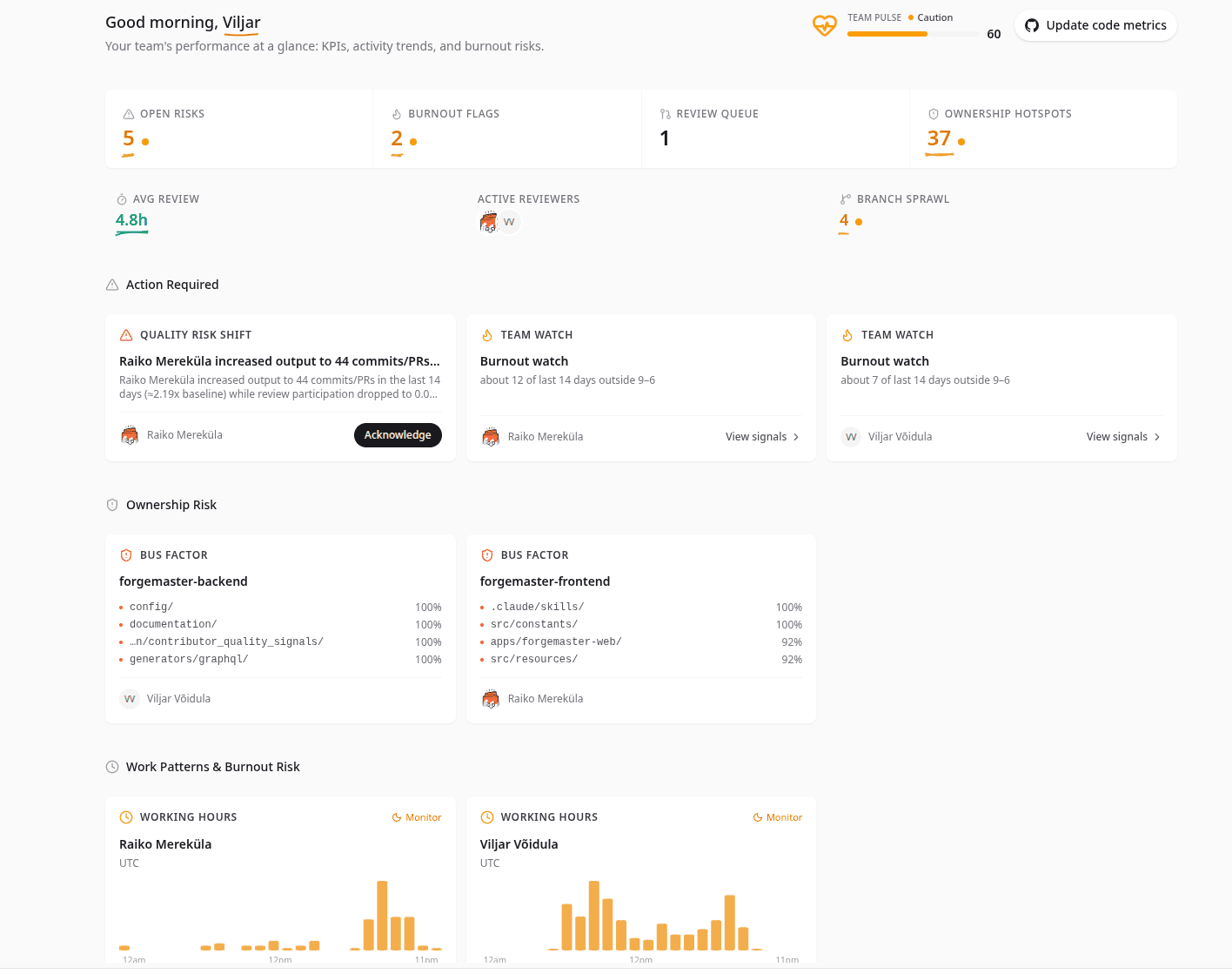
Forgemaster is strongest when the risk is not visible in the code itself.
For example, the codebase may be technically fine, but the team around it may be under strain. Reviews may be slowing down. A senior contributor may be carrying too much of the work. Incidents may be taking longer to resolve. A team may still be shipping, but only because people are quietly stretching themselves.
A code audit will not always catch that.
A repository can look reasonably healthy while the team maintaining it is becoming fragile.
Forgemaster helps answer questions like:
- Is the current pace sustainable?
- Are people risks emerging before they become attrition?
- Is knowledge concentrated operationally, not just structurally?
- Are incidents becoming a larger drag on delivery?
- Is the team getting blocked by review or coordination patterns?
That makes Forgemaster useful for ongoing engineering leadership. It is less about inspecting the codebase as a static object and more about understanding the engineering organization as it moves.
What StackGrit catches that Forgemaster does not
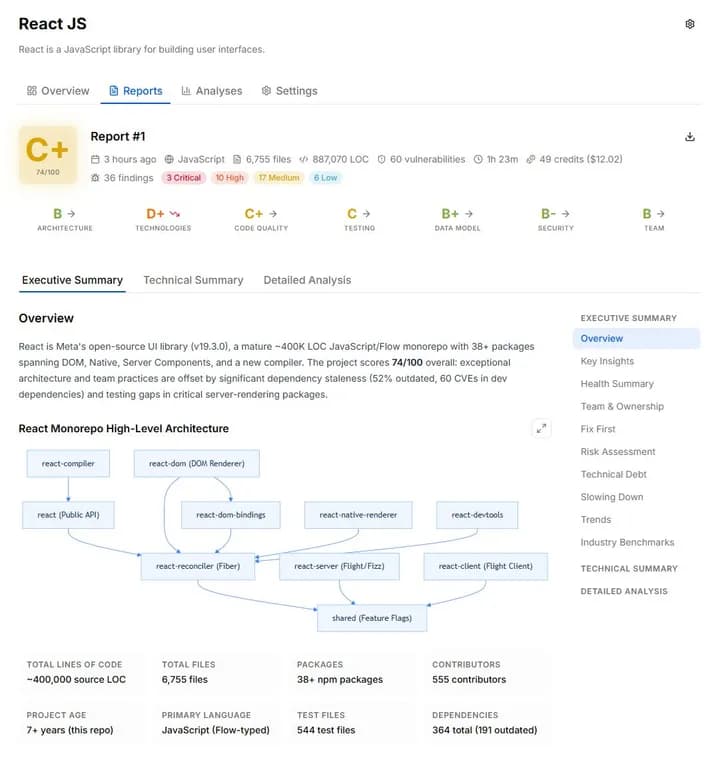
StackGrit is strongest when the risk is inside the codebase.
This is common when a company inherits software, buys a project, works with an agency, uses contractors, or builds quickly with AI coding tools. From the outside, the project may look functional. It may demo well. The team may be responsive. But under the surface, the code may have weak architecture, duplicated logic, fragile tests, hidden security issues, or outdated dependencies.
Operational metrics will not always catch that.
A team can move quickly on top of a codebase that is quietly becoming harder to maintain.
StackGrit helps answer questions like:
- Is this project built on a solid technical foundation?
- What are the highest-risk parts of the codebase?
- Are there known security or dependency issues?
- Which areas have little or no test coverage?
- Where is complexity likely to slow future development?
- What should we fix first?
That makes StackGrit especially useful for audits, handovers, acquisitions, outsourced development reviews, AI-generated projects, and quarterly technical health checks.
If you want to see the style of output, StackGrit also provides a public example report.
The team overlap: burnout vs bus factor
The most confusing overlap is "team" analysis.
Both products can tell you something about people. But they mean different things by that.
Forgemaster's team view is operational. It looks at contribution patterns, delivery flow, review behavior, incident involvement, and activity over time. The concern is whether the team is running well right now and whether the current rhythm is sustainable.
StackGrit's team view is structural. It looks at git history and code ownership to show who understands which parts of the system. The concern is knowledge concentration: if someone leaves, which subsystem becomes risky?
Those are both people signals, but they answer different questions.
Forgemaster asks:
Is the team healthy and operating sustainably?
StackGrit asks:
Where does critical knowledge live inside the codebase?
One is about the motion of the team. The other is about the structure of knowledge.
When to use Forgemaster
Use Forgemaster when you need a continuous read on engineering operations.
It is the better starting point when:
- you manage a growing engineering team
- burnout or workload imbalance is a concern
- review speed and delivery rhythm matter
- incidents are part of your operating model
- leadership wants weekly visibility without manually collecting updates
- you need to spot people and process risks early
Forgemaster is especially useful once the team is large enough that intuition is no longer enough. A founder can often feel what is happening in a three-person team. That stops working as the company grows.
When to use StackGrit
Use StackGrit when you need to understand the codebase itself.
It is the better starting point when:
- you inherited a codebase
- you are reviewing outsourced development work
- you are evaluating a project before investing more money
- you used AI coding tools and want an independent quality check
- you need a report a non-technical stakeholder can understand
- you want a baseline before starting a refactor
- you want to track code health over time
StackGrit is particularly useful when the buyer does not have the time, access, or technical depth to manually inspect the project. It turns a code review into a structured report that can be shared with a team, client, investor, or board.
You can run a free first analysis without a credit card.
When to use both
Use both when you need full coverage.
A healthy engineering organization needs two truths at the same time:
- The team must be sustainable.
- The codebase must be maintainable.
Forgemaster helps you see whether the team is operating well.
StackGrit helps you see whether the codebase is in good condition.
Together, they cover the two most common blind spots in engineering leadership. A team can be overloaded even if the codebase looks fine. A codebase can be fragile even if the team looks productive. Seeing only one layer can create false confidence.
For example:
- A CTO preparing for growth could use StackGrit to establish a code health baseline, then Forgemaster to monitor delivery and team health as hiring scales.
- A founder taking over an outsourced project could use StackGrit to understand what was built, then Forgemaster to manage the team operating it.
- An engineering manager could use Forgemaster weekly and StackGrit quarterly.
- A board or investor could use StackGrit for technical diligence and Forgemaster for ongoing engineering visibility.
The two products are adjacent, not redundant.
Pricing and cadence
Forgemaster is priced as an ongoing team monitoring product. Its value comes from continuous visibility: trends, rhythm, people signals, incidents, and leadership digests over time.
Forgemaster pricing starts with a Starter plan at 99€/month. That plan is designed for smaller teams that want a lower monthly commitment, included starter credits, and direct control over extra usage through manual credit top-ups. It includes one team, up to three connected repositories, up to five scheduled reports, up to ten unique recipients, and up to ten contributors analyzed and tracked.
The Growth plan starts at 199€/month and is meant for teams that want broader recurring monitoring rather than a light first setup. Enterprise is custom priced for buyers that need larger limits, dedicated onboarding, self-hosted or on-prem deployment, custom LLM configuration, or more hands-on support.
StackGrit pricing starts at 29€/month for the Starter plan, with higher tiers for teams and businesses that need more analyses. The first analysis is free, which makes it easy to get an initial read before committing.
That pricing difference reflects the product difference.
Forgemaster is something you keep running.
StackGrit is something you run when you need a codebase health report, then repeat when you want to track change.
The honest recommendation
If your team feels healthy but the codebase is a black box, start with StackGrit.
If your codebase is understood but the team is showing strain, start with Forgemaster.
If you are responsible for both technical risk and team performance, you should probably evaluate both.
The key is not to ask one tool to do the other's job. Forgemaster is not a substitute for a code audit. StackGrit is not a substitute for operational team monitoring.
One reads the engineering organization in motion.
The other reads the software asset itself.
That is why the best comparison is not really "which product wins?" It is "which question are you trying to answer first?"
If the question is code health, start with a free StackGrit project health report.
If the question is team health, start with the burnout risk demo or book a guided demo for continuous engineering intelligence.